However you fold and store your jackets (more on that in a minute), there are a couple of ways to always minimize the damage to it:
First off, avoid folding the jacket at all. If you’re flying, wear at least one of your jackets onto the plane so that you don’t have to pack it at all, apart from maybe a couple hours in the overhead.
Whenever possible, use a full-length garment bag and keep the jacket on a hanger. These work on airplanes or in cars, but they’re limited in carrying capacity.
If you do have to fold, minimize the number of folds needed, and try to keep them along the seams. The less you have to fold across a flat plane of fabric, the better.
Where possible, stow the jacket with the lining facing outward, not the surface. If the lining gets scuffed, stained, or torn in transport, it won’t show when you’re wearing it, whereas damage on the outside can ruin the jacket, or at least require immediate repair.
It doesn’t do anything about the bulk (we’ll show you some creative folds in a minute that will help with that), but treating the jacket gently in the first place, no matter what you’re doing, can help it get to its destination crease-free and ready to wear.
How To Fold A Suit Jacket – 3 Ways To Pack Sports Jackets & Suits
As far as clothing maintenance goes, packing and transporting men’s suit and sports jackets is pretty high on the list of aggravating tasks.
A good wool jacket combines two major problems when it’s not on your shoulders: it’s bulky, and it’s vulnerable to permanent creasing if a fold gets pressed into the fabric. You can steam or iron those out later, in most cases, but it’s still extra work, and hard on the jacket’s longevity.
It’s a problem that cries out for a solution. Fortunately, we have three for you.
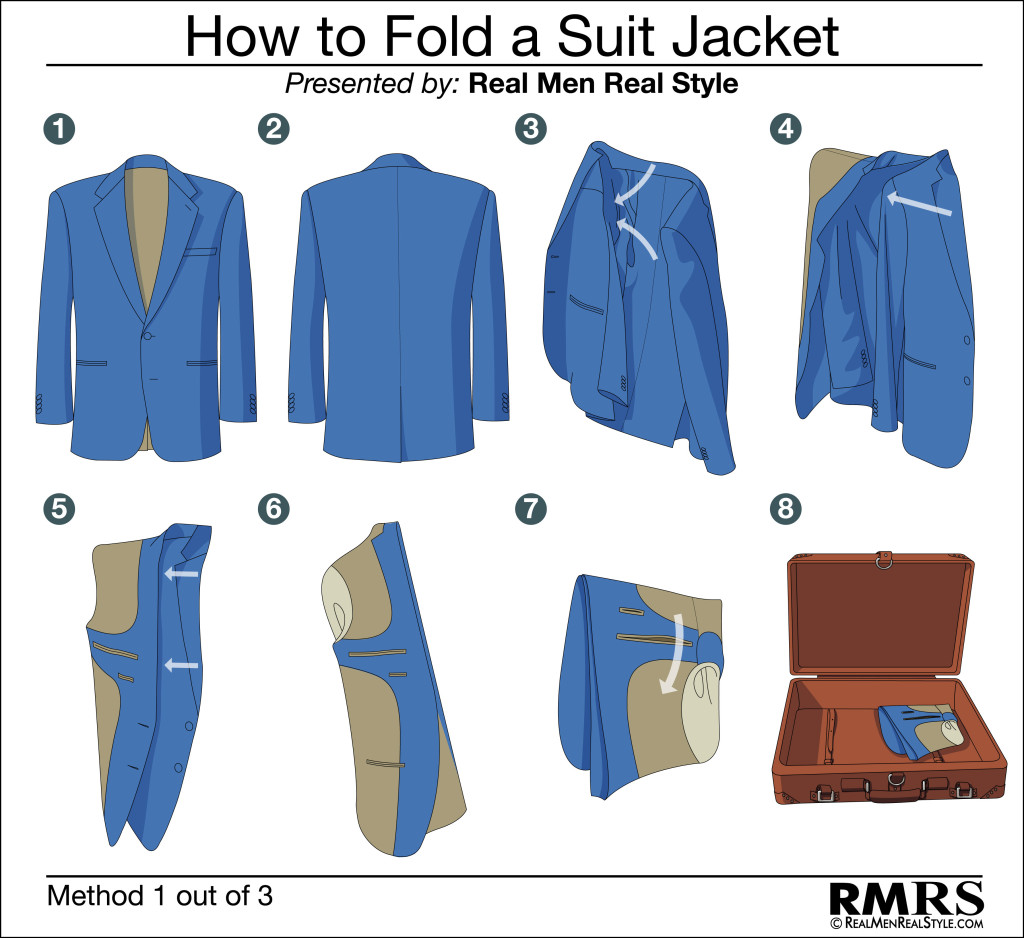
Jacket Fold Style #1 - Tucked-Shoulder Fold
This one does involve a large fold down the center of the jacket, meaning it’s not quite as crease-proof as a good roll.
That said, you often have to fold a jacket to get it into a suitcase — especially when space is very limited — and a flat fold is sometimes the only way to go. This one’s better than most, and reduces the number of folds that aren’t on seams to one.
Basically, you gently work one shoulder inside-out, then tuck the other shoulder into it, seam against seam. The sleeves lie straight down the jacket, one on top of the other, and the breast panels (with their linings turned outward) sandwich the whole thing. Then you fold it in half from the bottom and pack it away.
This one’s good for when you need a flatter fold than a roll and the jacket is going to be stowed for a while. If you’re good about not stacking too much weight on it, the crease down the middle shouldn’t set, and you’ve got the jacket lining protecting the outside of the jacket from any wear or tear.
Its big disadvantage, other than the single fold that can potentially crease, is that it can take a couple tries to get it right, and that you generally need a clean flat surface to do it on. It can be done standing and holding the jacket, but it’s tricky.
Jacket Fold Style #2 - The Shirt-Style Fold
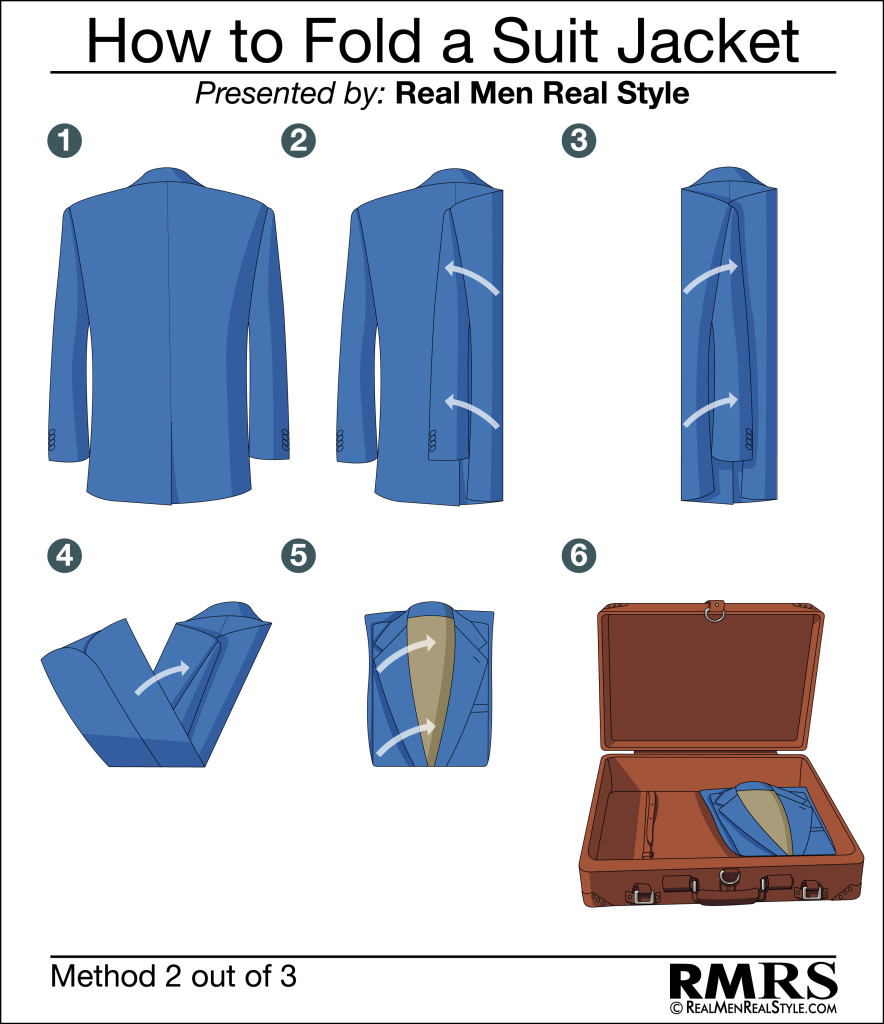
For the guy on the go, sometimes the easiest way to deal with the jacket is just to quickly fold it over like a dress shirt.
The sleeves tuck behind the back, with the shoulders overlapping slightly at the middle, and the whole thing gets folded in half from the bottom, tucking the bottom hem up underneath the collar. The lapels and collar sit right on top, and you get a pretty neat square shape.
The resulting bundle is about the same size as the one you get in Option #2, but a little thicker in the middle and not quite as even.
The big problem here is that you’re folding the jacket in several places, both vertically and horizontally. That’s a good way to get at least some creases, especially where the folds cross each other.
So why bother mentioning it? It’s a lot quicker to throw together than the other two folds, and it’s easy to do without a flat surface. You just tuck the collar of the jacket under your chin and make three quick folds, and bam, you’re done.
If you know you’re just going to be throwing the jacket on top of a case for a short period, this’ll work just fine. For longer travel, or if it’s going to have weight pressing down on it, you’re better off with one of the other methods.
Jacket Fold Style #3 – The Jacket Roll
My personal favorite!
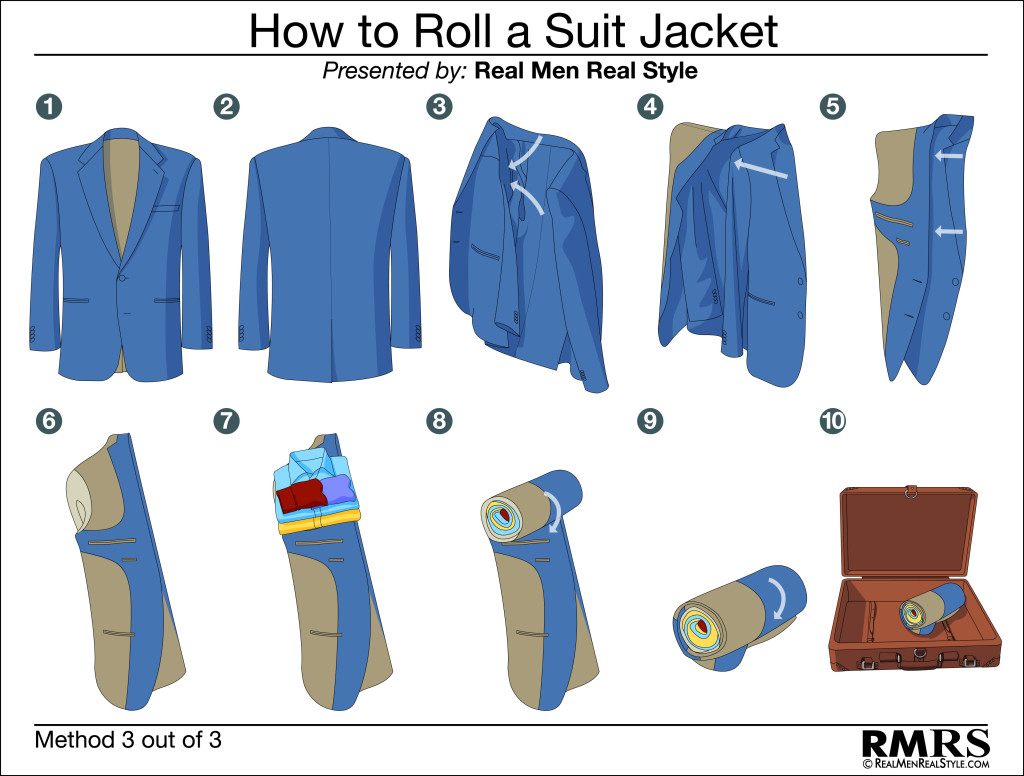
To get the least number of folds possible, there’s an easy solution: don’t fold the jacket at all.
You still need to do some creative tucking and layering, but it is possible to roll the whole jacket up (rather like a sleeping blanket or sleeping pad) into a soft tube of fabric.
The big advantage here is that, properly done, a rolled jacket is never folded across the fabric. Most of the action happens around the shoulders and sleeves, which are made to flex, and the broad front and back panels of the jacket get bent gently into a curve rather than pressed flat into a corner.
You can also usually tuck a shirt or a couple pairs of underwear into the roll, if you’ve got a deep enough suitcase. Just don’t try to cram too much in there — the roll won’t hold as well, and you’ll be more likely to wrinkle your jacket in the process.
The main disadvantage of a roll is that it takes up more space (especially vertical space) than a flat fold, and that it can sometimes take a few tries to get it right with no wrinkles.
And remember, you need to take those extra tries — if you force the jacket into storage with interior wrinkles, they’re likely to crease.
Merry Christmas Eve to you, your family, and your friends.
Please enjoy this special treat from the Concordia College Choir. If you are ever cruising through the valley of the Red River of the North, stop by the College. The campus is beautiful and the choir is amazing.
Williston, N.D., is ground zero in America's energy renaissance, with six-figure salaries the norm and stunning prosperity that extends from the oil and gas derricks to the construction, sales and service industries. But for much of the burgeoning population that has converged on Williston and other towns on the Bakken Formation, Christmas will be spent where the jobs, not the loved ones, are.
Not so for Sherri Knapp and Elijah Moyo, who are reunited this year as Moyo settles in to his lucrative new life as a crane operator. Knapp has traveled north from Florida to join her husband as they make their new home in prosperous Williston.
“It’s wonderful. Things are a lot better,” Knapp told FoxNews.com. “Last year he came home two weeks before the holiday, but this year we will be together on Christmas.”
The story of Moyo, originally from Zimbabwe, is not unlike many of the thousands of men drawn to the modern-day gold rush in the once sleepy state. The couple was living in their new home in Florida when Moyo sought the builder to pose a question about the dishwasher. He found his man - in North Dakota.
"He said he was in North Dakota building homes," Kapp said. "When Elijah asked him why he was up there he asked her husband if he had heard about the oil production.
Moyo quit the two jobs he held to make ends meet and went north and try to find opportunity. He started out as dishwasher at one of the worker camps. But soon after, he had earned his crane operator’s license, and 14 months later he found a big-paying job with Basin Concrete. He said he earns four times what he made working two jobs in Florida.
With an unemployment rate of just one percent, Williston is booming. Homes and new businesses are being built daily as more workers arrive seeking steady work. Like Moyo, they typically send for their families one they settle in. Williston is braced to expand from just 12,000 residents to an estimated 90,000 within 15 years.
“We’re growing as fast as you can grow,” Lee Lusht, president of the Williston Chamber of Commerce, told FoxNews.com. “We’ve built 2,500 units of housing this year."
If you’ve got a clear, straightforward guide (like this one), figuring the whole thing out is a project of less than an hour.
Black Tie Basics
First, a few things you need to know about black tie attire:
1. Black Tie Is Not the Same as Formal Dress
It’s commonly assumed that black tie is the highest standard of dress for men.
In fact, black tie evolved from what was, at the time, fairly relaxed evening attire. The tailless tuxedo jacket gets its name from Tuxedo Park, an early 20th century enclave of trendsetting, fashion-forward New York swells.
The highest formal dress for the evening follows the “white tie” dress code, a similar but distinct set of clothing. In dress code terms, black tie is evening semi-formal attire. Which leads us to another important point…
2. Black Tie Is Not Daytime Wear
You know those herds of tux-wearing groomsmen you see at popular tourist attractions and photo op sites on nice days? They’re doing it wrong.
The trend is unlikely to stop, but for people who are serious about getting their formal and semi-formal dress right, tuxedos are evening wear only.
The usual rule of thumb is that you dress for the end time of an event. So a long ceremony that starts in the afternoon and ends after dark is tuxedo-appropriate, but one that starts in the morning and ends in the afternoon when the sun is up is not.
That said, the invitation is always your guide. If a well-meaning friend has requested “black tie” for his morning wedding, you show up in your tux and you don’t say a word about it. Being a good guest counts for more than being right.
3. Black Tie is Not a Costume
You’re not pretending to be a character when you wear black tie. It’s not a waiter costume, or a groom costume, or anything else.
It’s your clothing (even if it’s rented), and it’s the clothing you wear when you want to make it clear to someone that you care about their event. It’s a gesture of respect in clothing form. Treat it as such, not as a novelty.
Proper Black Tie: How to Wear It Right
So now you know what black tie is (and isn’t). But how do you do it “right”?
There’s a pretty strict framework for black tie attire. It has a little flexibility on some of the small details, but by and large it’s a uniform look.
Here we’ll describe, piece by piece, the “gold standard” black tie look. Where you’ve got options, we list them. Where you don’t, we don’t. Trust us on this one and don’t believe what the guy at the rental place tells you.
The Tuxedo Jacket
This is the centerpiece — the item from which the whole outfit takes its name.
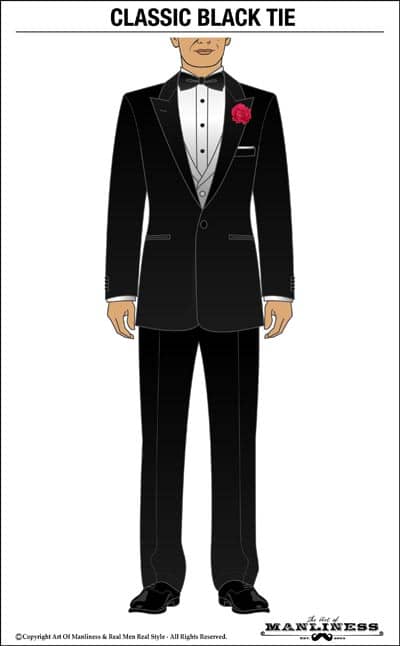
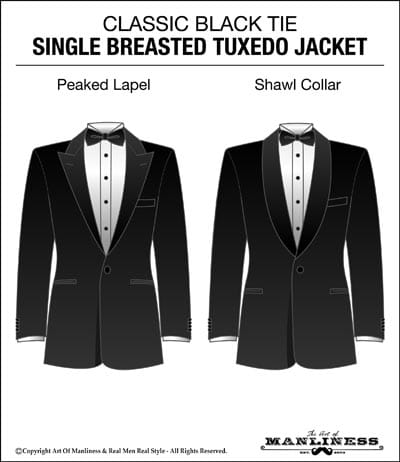
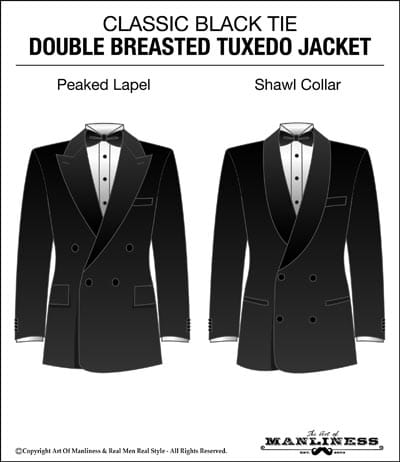
At its base, a tuxedo jacket is a tailless dinner jacket made of black or midnight blue worsted wool, with lapels “faced” (covered) in black silk. Most are single-breasted, with a single button, but double-breasted jacket models are also acceptable.
A few elements of the jacket have multiple accepted styles:
The Lapels — The most formal style of lapel is peaked, but a shawl collar is equally acceptable. In a shawl collar, the lapels are joined to the collar to make an unbroken loop around the shoulders and the back of the neck. Notch lapels are worn today, but purists still consider them too business-styled for semi-formal attire. In all cases, the left lapel should have a working buttonhole so that a boutonnière may be worn.
The Facing – Satin silk provides a smooth, high-luster surface that emphasizes the lapels. Grosgrain, with its ribbed texture, is subtler and less reflective. Both are equally acceptable. Since your neckwear will match your lapels, be aware that a satin facing means a shinier bow tie as well.
The Vents — For the slimmest silhouette and strictest formality, an unvented jacket is preferred. However, double vents (twin slits up the back) are also acceptable, and may be more comfortable and allow easier pocket access. Single vents are a casual style that should be avoided — be cautious when renting, as single-vented jackets are cheap and easy to fit, and have become a staple of rental catalogs.
The Buttons — All the buttons should match, but they may be either plain black or covered in the same facing as the lapels. The sleeve should have four touching buttons, just like a suit jacket.
Apart from those, everything should be uniform. The lower pockets should be jetted (slits, with no flaps), and you’ll need a welt breast pocket for your pocket square.
The ideal fit is a close one, with no pinching that would hinder movement or wrinkle the fabric, and the jacket should be long enough to cover your rear end down to the widest point of its curve. Basically, if it fits like a good suit jacket, you’re in good shape. There’s no substantial difference.
The Trousers
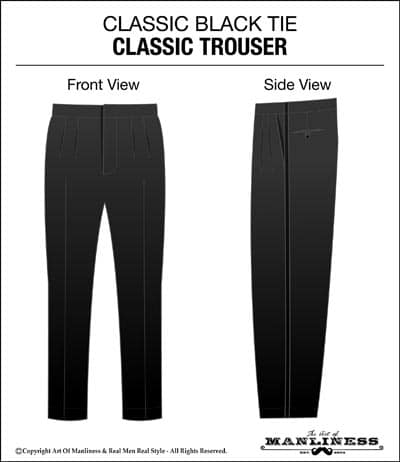
Black tie trousers are straightforward: they should be a perfect match to the tuxedo jacket.
That means the base material is the same as the jacket. The outer seams are concealed beneath a strip of ribbon (called the “braid”) made from the same material as the jacket lapel facing.
The trousers need to be high-waisted, so that the waist covering (either a waistcoat or cummerbund) can cover the waist fully. They will be worn with suspenders (“braces” in the UK), and should not have belt loops.
Beyond that, black tie trousers are simply minimal: they do not have cuffs, and the pockets are usually accessed by vertical slits at the back edge of the braid. Pleats are optional, but plain fronts will give the most elegant look.
The Waist Covering
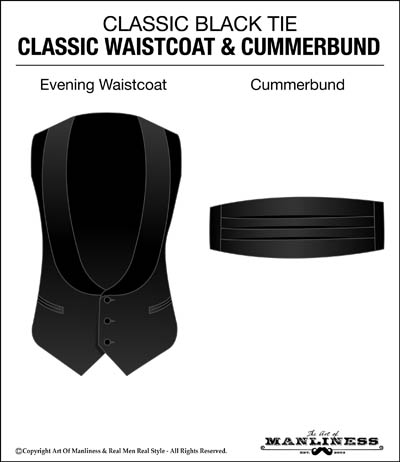
Black tie calls for one of two equally acceptable waist coverings: a formal waistcoat (vest) or a cummerbund (sash).
The formal waistcoat is the traditional option, and differs somewhat from the vest of a three-piece suit. It is cut low and wide, so as to show the front of the formal shirt underneath it, and has a small set of shawl lapels. Some are also backless, and fasten with a buckled or buttoning strap in the back. The vest is made from the same material as the jacket, and either the lapels or the entire vest can be faced in the same material as the jacket lapels. Both double-breasted and single-breasted vests are acceptable.
A cummerbund is a pleated sash that wraps horizontally around the waist. Traditionally, it is made from the same silk as the jacket lapel facings. The pleats face upward, like small pockets (which was actually their function, as early formal and semi-formal dress did not include trouser pockets). Some modern cummerbunds also have small hidden pockets on the inside.
Whichever waist covering you choose, it should conceal the waistband of your trousers all the way around. High-quality models will include small fabric tabs or loops that attach to matched buttons inside the trouser waist, to hold the covering in place.
Since the waist coverings are usually the first place that rental outlets start adding in color, it’s worth emphasizing: the gold standard for black tie is a black waist covering!
That said, you can sometimes get away with a cummerbund of another dark color, such as burgundy red or forest green, so long as your goal is a relaxed semi-formal look. It wouldn’t be appropriate for a high-formality diplomatic event or awards ceremony, but it would be fine at a wedding, for example.
Use discretion — and when in doubt, go with plain black. It has the advantage of always being right.
The Evening Shirt
The shirt that accompanies a tuxedo should always be plain white.
It functions similarly to a regular dress shirt, but has a few unique features that set it apart:
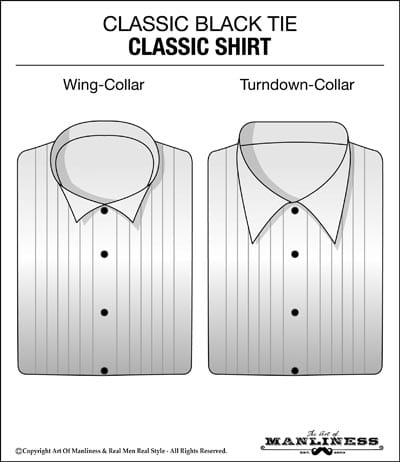
The Bosom – Evening shirts have a decorated rectangular panel that runs all the way up the front of the shirt. This is called the “bosom” or the “bib” of the shirt. The most common styles are pleated (where vertical pleats run up the shirt on both sides of the button placket) and piqué (where the front of the shirt is made from a stiffened piqué fabric, generally woven with a dimpled pattern called marcella). Both are equally appropriate, though piqué is considered slightly more formal. Pleated shirts are sometimes called soft-front, in contrast to piqué’s stiff-front. A starched soft-front is called semi-stiff.
The Studs – Instead of buttons, some evening shirts have buttonholes on both edges, which are closed with decorative studs. The studs are widely spaced, usually with no more than three or four to a shirt. Traditionally, studs are used for stiff-front shirts, while soft-front shirts use mother-of-pearl buttons.
The Cuffs – The French cuff is the standard for semi-formal evening shirts. These fasten with cufflinks. While many tuxedos are sold with matching studs and cufflinks, it is not required. The metals should come from the same color family, however, and the two should complement each other reasonably seamlessly — you don’t want gold studs and silver cufflinks, or anything similarly mismatched.
The Collar – You have your choice of two collar styles here: a wing collar or turndown collar. Wing collars are high, starched collars separate from the shirt, with small points that thrust outward beneath the chin. Some purists argue that the style is only meant for formal (white tie) attire, but it is worn with black tie often enough that you can get away with it. Alternatively, a simple point-style turndown collar is always acceptable. Button-down collars should never be seen in black tie.
It should go without saying, but your shirt should always be tucked into your trousers (some have small loops that button to the inside of the trousers to keep them in place). The bottom of the shirt should be covered by the cummerbund or waistcoat, as should the bottom of the bib if it is separate from the shirt.
The Bow Tie
The tie from which black tie takes its name should, of course, be black, and the material should match the jacket lapel facings. Do not use a pre-tied model!
If you aren’t familiar with how to tie it, you need to watch Brett’s video on how to tie a bow-tie.
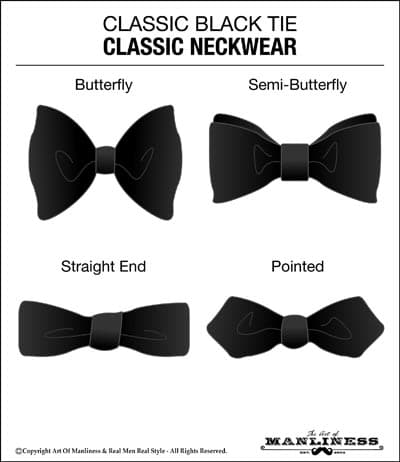
There are several styles of tie that are acceptable, mostly distinguished by thickness and by whether the ends of the finished bow are pointed or rounded:
Butterfly - Narrow at the center and wide at the ends, these are a timeless classic. It’s a good style for men with large, round faces.
Semi-Butterfly- Also called a “thistle” because the smaller sides often show doubled corners, giving it a slightly pointy appearance. This is a more modern and slimmed-down version of the butterfly. It’s a neutral style, and works well with most faces.
Straight-End – Also called the “batwing” and “club” style. A good option for small men and men with thinner necks and faces.
Pointed – The ideal choice for men with sharp, angular features, and a natural complement to the points of peak lapels and wing collars as well.
There are no hard and fast rules as to which is preferable. It is largely a matter of taste, and of choosing a style that best matches the shape of your face. Large-faced, strong-featured men want thick ties, while men with narrower features look better in skinny ties.
The Shoes
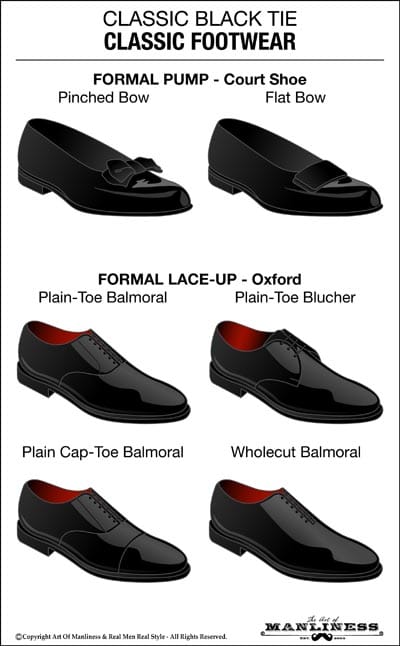
You have two style options for black tie shoes: formal pumps (also called opera pumps or court shoes), or black balmoral oxford dress shoes.
Formal pumps are made of patent leather or highly-polished calfskin, with a black grosgain ribbon on the top. If the ribbon has a bow tied in it, with a band lengthwise across the center, it is called a pinched bow pump, while a pump with only a flat ribbon crossing the top is called a flat bow pump. These formal shoes are the ideal complement to a tuxedo, but as they are expensive and single-purpose, many men shy away from purchasing them.
If you don’t want to shell out for formal pumps, a pair of highly-polished oxfords are also acceptable. A few men’s shoe styles have become accepted as accompaniments for tuxedos, listed here in descending order of formality:
Wholecut Balmoral – This is an uncommon style, wherein the uppers are a single piece of unbroken leather. A single slit is cut down from the opening and punched with eyelets for the laces. It looks quite sleek, and suits a tuxedo well.
Plain-Toe Balmoral – This is your basic high-formality business dress shoe. “Balmoral” implies that the lacing system is closed — that is, the piece of leather containing the eyelets is sewn directly into the upper of the shoe, not laid on top. That makes the top smooth and even, which is preferred for black tie attire.
Cap-Toe Balmoral- The same as a basic balmoral, but with the toe stitched onto the uppers, creating a horizontal line across the top about an inch back from the toe. It is a common business style, but bordering on too informal for black tie. Pair it with the more relaxed shawl collar, rather than peaked lapels.
Plain-Toe Blucher – Also called derbies, bluchers have an open lacing system, meaning that the pieces of leather containing the eyelets are separate from the uppers, and layered on top of them. Black tie has begun to tolerate the intrusion of these lower-formality shoes in the last few decades, but they are decidedly less impressive than your other options.
Thin black socks should be worn with whatever style of shoe you choose. Avoid thick cotton socks, even if they are black.
Other Considerations
With the jacket, trousers, waist covering, shirt, and shoes done right, your black tie outfit is basically assembled.
All that remains are a few finishing touches:
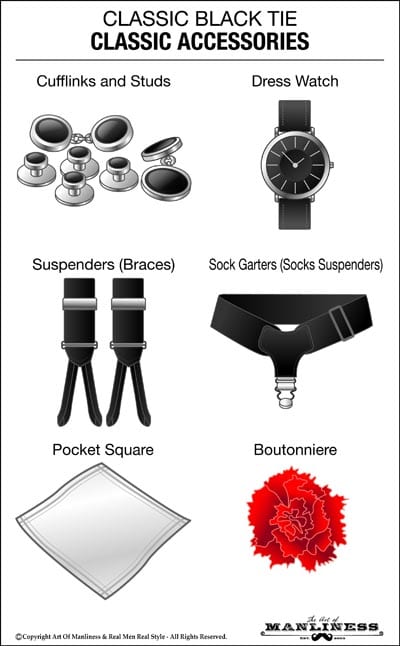
The Suspenders – These button to the trouser waist (you should never be wearing clip-on suspenders with black tie). Black or white are equally acceptable. The suspenders should be hidden beneath the waist covering and jacket the whole evening, and should never be visible.
The Pocket Square – Plain white is your only option here, preferably silk. Any fold is acceptable, and many gentlemen choose a deliberately mussed style like a puff or fluted fold to add a touch of contrast to the otherwise sharp-edged look of black tie.
The Boutonnière – A flower in the lapel is entirely optional, but always correct so long as it is a single blossom, preferable in white or red.
Watches – Classic evening wear does not include a watch of any kind (the implication that you would check the time is considered rude to the hosts). These days, however, a wristwatch is tolerated, so long as it is slim, with a black band and metal detailing that matches your studs and cufflinks. A pocket watch makes an excellent alternative that can stay hidden until you discreetly check it.
If you need outerwear, a dress overcoat in black, navy blue, or charcoal gray wool is acceptable. A black or navy blue fedora or homburg is acceptable, but top hats are not — those are a formal accent reserved for white tie attire. Scarves, if worn, should be white (learn how to tie a scarf 11 different ways).





 . “Last year he came home two weeks before the holiday, but this year we will be together on Christmas.”